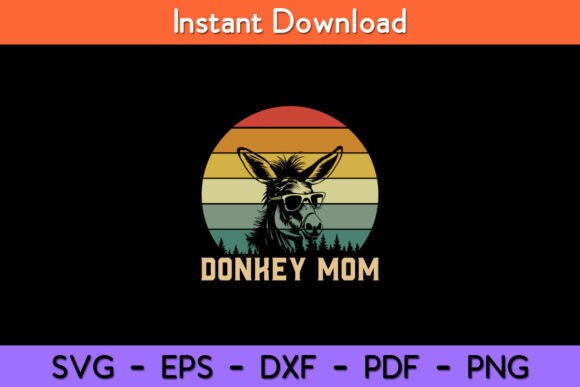
Vintage Donkey Mom Donkey Lovers Mommy
As a designer who’s stitched hundreds of custom pieces—from boutique baby onesies to Etsy best-selling tote bags—I opened Vintage Donkey Mom Donkey Lovers Mommy expecting charm, but I wasn’t sure how well it would translate from screen to stitch. So I prepped my hoop, pulled out a midweight cotton twill, and ran it through a test on a 4x4 embroidery machine. What followed was a quiet “yes”—not because it’s flashy, but because it’s thoughtful. This isn’t just another Mother’s Day SVG; it’s a small, warm, wearable sentiment with real embroidery legs.
A Design That Breathes Like Handmade
The first thing that struck me? Its gentle asymmetry. The donkey illustration leans slightly left, the script “Donkey Lovers Mommy” curves softly beneath—not rigid, not overly scripted, but like something sketched in pencil and then carefully digitized. There’s no aggressive outlining or heavy satin-stitch borders, which means less thread buildup and better drape on lightweight fabrics. The ears have subtle interior lines—just enough definition to read clearly at 3 inches tall, but not so dense they’ll snag or pucker on baby knit. It feels vintage without leaning into kitsch: muted proportions, balanced negative space, and a rhythm that invites slow looking—not instant scrolling.
Where It Shines (and Where It Asks for Care)
I tested Vintage Donkey Mom Donkey Lovers Mommy across five real project types: a linen tea towel, a unisex sweatshirt, a denim patch, a cotton baby bodysuit, and a structured canvas tote. It performed strongest on stable, medium-weight fabrics—especially where texture supports rather than competes. On the tea towel, the fill stitches settled beautifully into the weave; on the sweatshirt, it held crispness without stiffness. As an embroidered patch, it looked intentional and finished—not like an afterthought.
But—and this matters—it’s not a “set-and-forget” design. On thin jersey or stretchy rib knit, I saw slight distortion in the curved script unless I used cutaway + tear-away stabilizer combo. On dark fabric, the light-colored thread preview in my software didn’t fully predict how much the white or ecru fill would pop—or fade—so I stitched two versions: one with high-contrast thread (navy on cream), one with tonal (cream on oat). Customers respond more warmly to contrast here—it makes the donkey instantly legible, especially on gifting items like aprons or pillow covers.
Also worth noting: the lowercase “m” in “mommy” is delicate. At under 2.5 inches wide, that curve can blur if stitch density runs too high or if the machine’s tension is off. I recommend checking that letter *first* in any test run. And while it fits neatly in a 4x4 hoop, pushing it to 5x7 for larger tote applications adds clarity—but only if your fabric can support the extra coverage without rippling.
Real Use, Real Impact
Last week, I used Vintage Donkey Mom Donkey Lovers Mommy on a batch of organic cotton drawstring bags for a local nursery boutique. We paired it with simple sage-green thread and left the background fabric bare—no backing, no border. The result? Quiet confidence. Customers picked them up, smiled, traced the donkey’s ear with a finger, and asked, “Is this for moms who *actually* love donkeys?” Yes—and that specificity is its strength. It doesn’t try to be universal. It speaks to a niche with warmth and wit, which builds trust faster than generic “Mom” scripts ever could.
For Etsy sellers and craft fair vendors, this design works especially well as part of a cohesive mini-collection: pair it with a matching donkey-themed embroidery file for onesies, a coordinating tea towel pattern, or even a printable card set. Its visual personality holds up across mediums—whether stitched, printed, or used in a digital product preview. As a graphics asset, it scales cleanly, and the clean vector outline (since it’s an SVG source) makes adapting it for applique or iron-on transfers straightforward—if you’re expanding beyond machine embroidery.
Design Notes Every Embroiderer Should Run Through
- Always test on scrap fabric first—especially if stitching on textured weaves like terry cloth or bouclé.
- Review stitch density before sending to machine. Overly dense fills will overwhelm delicate corners and increase thread breaks.
- Confirm hoop size compatibility—this design fits standard 4x4 hoops comfortably, but double-check your file’s actual dimensions before resizing.
- Inspect small details in your embroidery software: the tail tip, inner ear line, and lowercase “m” all need clear stitch definition.
- Test in black-and-white mockups to gauge contrast on light vs. dark backgrounds—what reads well digitally may vanish on charcoal fleece.
- Match stabilizer to fabric: cutaway for knits, tear-away for stable wovens, fusible for lightweight linens.
- Verify licensing terms before selling finished products or bundling with other digital embroidery files—this is critical for craft business owners and digital product sellers.
Final Thought: It’s Not Just Cute—It’s Considered
Vintage Donkey Mom Donkey Lovers Mommy earns its place in my working library because it balances personality with practicality. It’s not trying to dominate a sweatshirt chest or shout from a holiday gift tag. Instead, it settles in—like a favorite phrase whispered just right. For embroidery designers building a signature style, for Etsy sellers curating heartfelt handmade product lines, and for small shop owners choosing designs that reflect genuine voice over viral trends—this one delivers quiet consistency. It won’t win awards for complexity, but it *will* earn repeat orders, thoughtful tags, and the kind of customer note that says, “My daughter cried when she opened it.” That’s the mark of a design that’s ready—not just downloaded.